

Feed AI Your Market Data to Stop Generic Content

Quick Read (the whole post in six bullets):
Generic prompts make generic content, because every agent is feeding AI the same public information.
Your edge is your local data: one ZIP code, its buyers, its sold homes, and your own voice.
Pick one ZIP, ideally one neighborhood inside it, and go deep instead of wide.
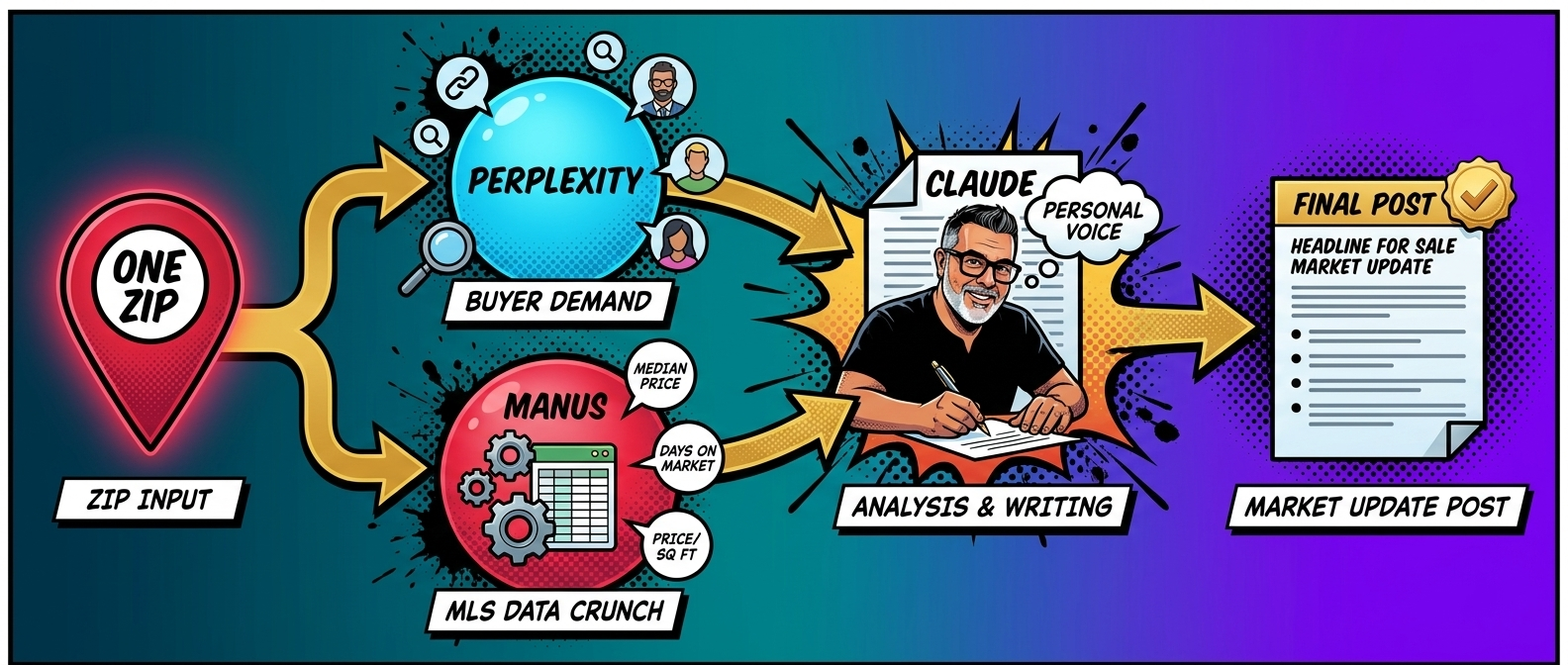
Step one, use a Perplexity prompt to learn what buyers in that area actually want.
Step two, feed the sold-home MLS data into Manus and have it analyze the market.
Step three, bring both into Claude in your voice, and you come out looking like the local expert.
You ask AI to write a post about the market, and what comes back could run in any city in America. Rates are shifting, inventory is tight, now is a great time to make a move. It is technically true and completely forgettable, because you gave the model nothing that only you would know.
The fix is in the input. Feed the model real information from your own market, the actual ZIP code and the actual numbers, and the generic disappears. Here is how to do it in three steps.
Why AI writes generic content
It helps to understand why the output is so bland in the first place.
Every agent is reaching for the same tool and typing roughly the same prompt, and that tool is working from the same public information for all of them. So everyone's post lands on the same handful of safe lines about rates and inventory. The model is doing exactly what you asked. It is handing back the average of everything ever written about real estate, because the average is all a generic prompt calls for. A generic prompt about "the market" can only produce a generic post about the market.
The thing that breaks the pattern is information the model could not have without you, and you are sitting on a pile of it.
Go hyperlocal: pick one ZIP code, even one neighborhood
Before you feed AI anything, narrow your target further than feels comfortable.
Most agents want to cover the whole city, because it feels like a bigger audience. That is the reason their content stays shallow. Pick one ZIP code, and if you can, one neighborhood inside it, and decide to own the data for that small patch of the map. A post about the 75013 market with a real median days on market and a real price per square foot beats a post about "the Dallas market" every time, because it is specific enough that only someone who works that area could have written it. Depth is what reads as expertise, and width just reads as noise.
Once you have picked your patch, you feed AI three layers of it, and the first is demand.
Step one: use Perplexity to learn what buyers there actually want
Start with the people, not the numbers. Before you talk about price, you want to know who is buying in that area and why.
Perplexity is the tool for this, because it pulls current information and shows you the sources so you can trust what you are using. Ask it about the specific ZIP or neighborhood: who moves there, what they do for work, what they love about living there, and what surprises newcomers. Here is a prompt you can adapt:
[Research [neighborhood], [city], [ZIP] for a real estate audience. Tell me who typically buys homes here and why, what residents love most about the area, the top schools, restaurants, and amenities nearby, and what people moving here from out of town say surprised them in a good way. Include your sources. ]
That gives you the demand side in the buyer's own language, which is the part generic content always misses.
With demand in hand, you add the layer no competitor can copy, your actual numbers.
Step two: feed your sold-home MLS data into Manus
This is the step that turns your content from opinion into authority.
Pull the MLS data for every home sold in that ZIP over the last 6 to 12 months and hand the whole set to Manus. Then tell it to analyze the numbers for you:
[Here is the MLS data for every home sold in [ZIP] over the last 12 months. Analyze it as market data. Give me the median sale price, average price per square foot, average days on market, sale-to-list-price ratio, and the overall trend across the period. Point out anything a buyer or seller in this area should know. ]
Manus does the heavy analysis you would never sit down and do by hand, and the result is a set of real, local numbers that belong to you. This is your proprietary layer, and it is worth confirming before you publish it, which is the habit I wrote about in can you trust AI for market research. You bring the data, the tools organize it, and you check that it is right.
Now you have demand and numbers, and the last step turns them into content that sounds like you.
Step three: bring both into Claude in your voice
This is where it all comes together.
Take the Perplexity research and the Manus analysis into Claude, which already knows how you talk, and ask it to write the piece you need. A market-update post, a caption, a video script, or an email to your database. Because Claude now has real demand and real numbers to work from, and your voice to write in, the output stops sounding like a template and starts sounding like the neighborhood expert who pulled the data. One idea, grounded in your ZIP, in your words.
To see why this matters, put the two versions side by side.
What this looks like as one piece of content
Here is the same market update, written both ways.
Before, generic: "The market is shifting and interest rates are on everyone's mind. Now is a great time to buy or sell, so reach out to talk about your options."
After, data-fed: "Homes in 78704 sold in an average of 21 days last quarter, and the price per square foot is up about 4% from a year ago. Buyers moving here from out of state keep telling me they came for the walkability and stayed for the food scene. If you own here, that combination is why your equity is holding, and it is worth a conversation before the spring rush."
The market under both posts is the same. Only one of them proves you were paying attention.
This is what makes you the local expert
There is a bigger payoff here than one good post.
Anyone can type "the market is shifting" into a caption. Only you can post the real numbers for your neighborhood and tell people what they actually mean for a buyer or a seller there. That specificity is authority, and it compounds. Every data-fed post quietly proves that you know your patch of the map better than the agent down the street, and over a year of them, you become the name people in that ZIP think of first.
That reputation is built one specific, sourced, local post at a time.
Wrapping it up

The tool everyone else is using is the same tool you are using. What separates your content is what you put into it.
Feed AI one ZIP code worth of real demand and real numbers, write it in your voice, and the generic disappears. Do that consistently, and you stop sounding like every other agent with an AI account and start sounding like the one who actually knows the neighborhood.
Frequently Asked Questions
Q: Why does AI write such generic real estate content?
A: Because a generic prompt only gives it the public information every other agent is also using, so the output lands on the same safe lines about rates and inventory. AI writes something specific only when you feed it something specific, like your ZIP code's real numbers and buyers. The tool is fine, and the input is what is missing.
Q: How do I make AI content sound local and specific?
A: Give it local, specific inputs. Feed it research on who buys in one neighborhood, the real sold-home data for that ZIP, and samples of how you talk, and the writing follows. The more real detail you put in, the less generic the output.
Q: What data should I give AI to write about my market?
A: Three things. What buyers in the area actually want, the sold-home numbers for a single ZIP or neighborhood, and a feel for how you talk. Those three layers are what turn a generic post into one only you could have written.
Q: Should I focus on one ZIP code or my whole city?
A: One ZIP code, and ideally one neighborhood inside it. Owning the data for a small area reads as real expertise, while trying to cover a whole city keeps your content shallow. Depth wins the local reputation you are after.
Q: What AI tools do I need to turn market data into content?
A: Three, each doing one job. Perplexity to research what buyers want, Manus to analyze your sold-home MLS data, and Claude to write it in your voice. You bring the data and the final read, and the tools handle the middle.
Q: How often should I pull new market data for my content?
A: Once a month is plenty for most neighborhoods, since sold-home numbers do not swing week to week. Pull fresh MLS data monthly, refresh the buyer research a few times a year, and you will always have current, local material to post from.
Want help setting this up?
If this helped, I walk agents through this exact setup on my YouTube channel and in my coaching, where I show the prompts and the analysis live on a real ZIP code. Come find me on YouTube and let's make your market the one you are known for.
