

How to Make AI Real Estate Scripts Sound Human
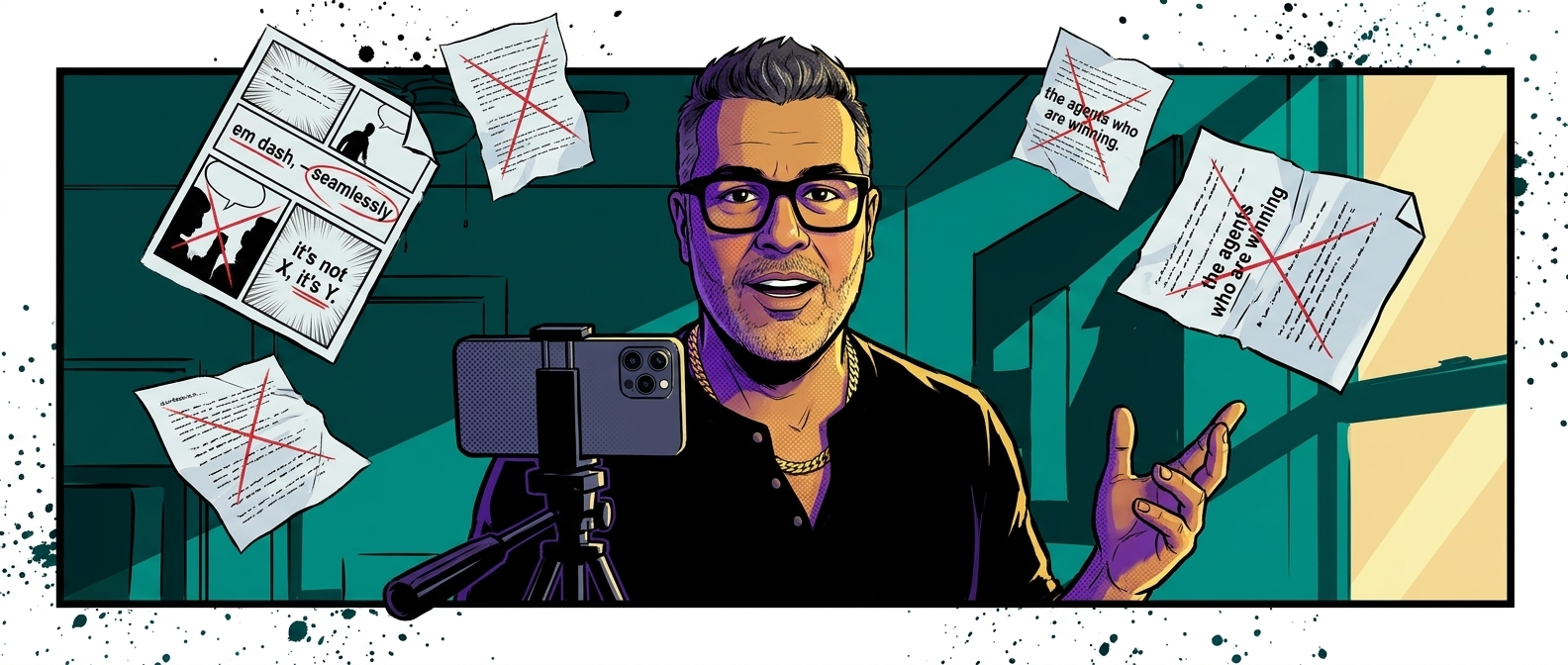
Quick Read (the whole post in seven bullets):
AI writes your script in seconds, but it repeats seven habits that make you sound like software on camera. That set of habits is called AI slop, and clients feel it before they can name it.
Cut the em dash. You never pause that way out loud, so replace it with a period or a comma.
Drop the false balance ("it's not that you're X, it's that you're Y") and just say the true half as one direct line.
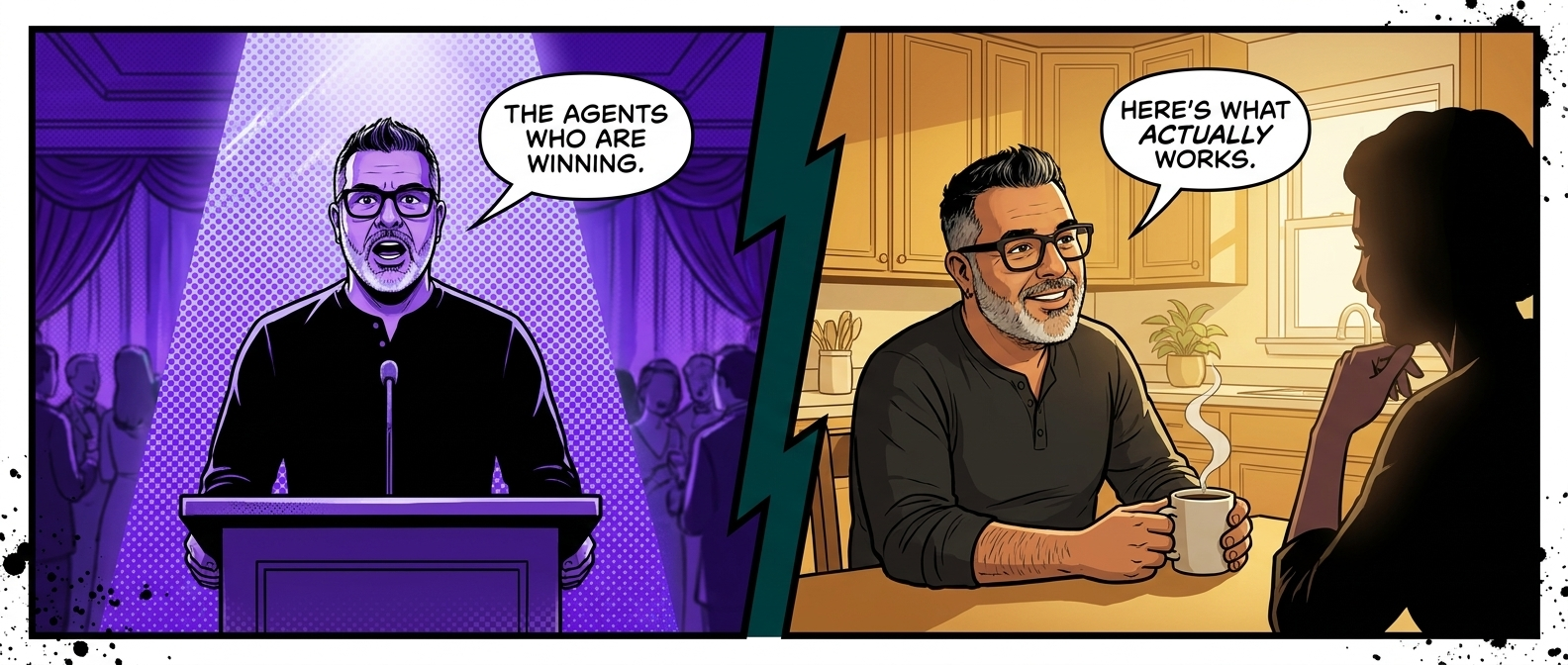
Stop using "the agents who are winning" stage language. Say the plain version, like "agents who post one video a week get more listing calls."
Kill the alliteration and pull out the "-ly" adverbs. They read clever on the page but sound like a jingle and give the buyer nothing to picture.
Use real transitions that carry one point into the next, instead of "moreover" or "additionally."
Tell Claude your rules up front so the first draft skips the tells, then read it out loud. If you would not say a line to a client's face, cut it.
The vehicle has changed. A couple of years ago you either wrote your own scripts or you skipped scripting and hoped the video came out okay. Now AI writes the draft in about nine seconds, and that part is fine, because the blank page was never the fun part of this job.
The problem is that AI has a handful of writing habits it repeats in almost everything it makes. When you read those habits out loud on camera, people can tell something is off even if they can't say why. This post walks you through the seven habits to strip out so your scripts sound like you instead of like software.
Why your AI script sounds fake even when the words are right
Most agents assume the problem is the information, so they keep feeding the AI more facts about the neighborhood and the listing. That is not where it breaks.
The words are usually correct. What gives it away is the pattern, the little writing habits AI repeats when you don't tell it otherwise. There is a name for this now, and it is worth knowing: AI slop. It's the smooth, over-polished, slightly hollow way AI writes by default, and your client can't quote you a grammar rule but they've read enough of it online this year to feel it. In a business that runs entirely on trust, that little flicker of "this feels off" is expensive.
Once you know the seven habits to look for, you can catch them in your own scripts in about a minute, so let's start with the one that shows up the most.
Cut the em dash first
If you fix one thing today, fix this. The em dash is the long dash AI drops into the middle of a sentence to bolt on an extra thought.
Here's what it looks like. AI writes, "This home isn't just updated, it's move-in ready from day one," and it connects those two halves with a long dash in the middle. You would never pause like that when you talk, because out loud an em dash is a speed bump nobody asked for. Replace it with a period or a comma and say it the way you'd say it across a kitchen table: "This home is updated and move-in ready from day one." Read both versions out loud and you'll hear the difference right away.
The em dash is the loudest tell, but the next one is sneakier, because it actually sounds smart.
Drop the false balance
This one feels profound, which is exactly why AI leans on it and why it slips past most people. The pattern is "it's not that you're X, it's that you're Y."
You'll see it as "it's not that you're bad at marketing, it's that you never had a system." Say that on camera and watch your own energy drop, because it sounds like a motivational poster instead of a person. Nobody stands in your kitchen and talks in that little seesaw rhythm. Pick the half that's actually true and just say it: "You never had a system, and that's the whole problem." One direct sentence lands harder than the balanced version every single time.
That seesaw rhythm is a guru habit, which brings us to a phrase that shows up in almost every AI script about success.
Stop saying "the people who are winning"
Ask AI to write anything motivational and it reaches for this one on the first try. "The people who are winning right now are the ones who..." and off it goes.
It's stage language. It sounds like someone selling from the front of a ballroom, not a coach talking to you across a desk. Your audience is 35 to 60, they have sat through plenty of those rooms, and they came to you specifically because you don't talk like that. Say what you actually mean instead: "Agents who post one video a week get more listing calls, and here's what they're doing." Same point, no ballroom.
The guru voice hides in the sound of the words too, not just the phrases, so that's the next thing to pull out.
Kill the alliteration
AI loves stringing together words that start with the same letter, because it reads as clever on the page. You'll get lines like "be confident, clear, and closing" or "consistent content converts."
It looks designed, and that's the problem. Out loud it sounds like a jingle, and jingles make people trust you less, not more, because they can hear the sales seam in it. Break the pattern on purpose so it sounds like a person thought of it in the moment. "Be confident, be clear, and ask for the sale" says the same thing without the sing-song.
While you're listening for rhythm, there's one more thing agents pile on without noticing, and that's the adverbs.
Pull the adverbs out of your scripts
Adverbs are the "-ly" words, and AI stacks them because they make a sentence feel busy without adding anything real. You've seen the result: "This home shows beautifully and flows effortlessly into a truly stunning backyard."
Read that out loud and count how much of it a buyer can actually picture. Beautifully, effortlessly, truly, none of it puts an image in anyone's head. Cut the padding and drop a real detail in its place: "The kitchen opens straight into the backyard, and there's room out there for a table that seats eight." Spoken language lives in verbs and nouns, not in a pile of "-ly" words.
Now your individual lines sound like you. The last piece is getting them to connect, which is where most scripts quietly fall apart.
Write real transitions between your topics
This is the one agents miss most, because AI hands you clean paragraphs that don't actually connect to each other. You'll notice it drops "moreover," "additionally," or "when it comes to" between points and calls it a day.
Those aren't transitions, they're filler that tells the viewer you changed subjects without telling them why. A real transition carries the last idea into the next one. Instead of "additionally, let's talk about pricing," you'd say, "so once the home is staged, the next thing that decides how fast it sells is the price." The viewer never feels the seam, and that's the whole difference between a video that flows and one that stops and starts.
You don't have to catch all of this by hand every time, because you can teach Claude to skip most of it up front.
What should I tell Claude so my scripts don't sound like AI?
Here's the part that saves you the most time. Instead of cleaning up AI slop after the fact, you tell Claude to leave it out of the first draft.
Give it a rule, not a wish. Something like this: "Write this real estate video script in a calm, plain, conversational voice. No em dashes. No 'it's not X, it's Y' sentences. No 'the people who are winning' language. No alliteration. Cut the adverbs. Use natural transitions between points, and write the way I'd actually talk to a client across a kitchen table." That one instruction removes most of the seven tells before you ever read the draft.
Then run the last filter, which is your own mouth. Read the script out loud at normal speed, and if a line makes you stumble or you'd never say it to a client's face, cut it. Your mouth catches what your eyes skip right over.
To see the whole system in one place, here's a real script cleaned up line by line.
A real listing video script, rewritten line by line
This is a standard walkthrough intro, the kind AI hands back when you ask it for a listing video and don't tell it anything else.
Before: "Welcome to this stunning, meticulously maintained home. It's not just a house, it's a lifestyle, and the people who buy in this vibrant community know that location, luxury, and lasting value matter."
Count the tells in those two sentences. You've got the false balance ("it's not just a house, it's a lifestyle"), the "the people who buy" framing, alliteration in "location, luxury, and lasting," and the adverbs in stunning and meticulously. That's nearly the whole checklist in two sentences, and it's exactly why the video sounds like a brochure reading itself aloud.
After: "Welcome to 412 Oak. It was built in 2019, the owners kept it in great shape, and the reason people move to this street is pretty simple. The elementary school is three blocks away, and you can walk to the coffee shop on the corner."
Same length, same amount of time on camera. One sounds like AI, and the other sounds like an agent who actually knows the street.
That's the entire method sitting in one example, and every script you write can pass the same test.
Wrapping it up
None of this means you stop using AI. The vehicle changed, but the job didn't, and AI is still the fastest way to get past the blank page and into a draft.
Your only real work after that is to make the draft sound like the person your clients already trust. Run the seven checks, read it out loud one time, and post it. That's the whole system, and it takes about a minute once your eye is trained for it.
Frequently Asked Questions
Q: Why do my AI-written real estate scripts sound robotic on camera? A: Usually it's not the information, it's the pattern. AI repeats a handful of habits like em dashes, "it's not X, it's Y" sentences, and stacked adverbs, and those read fine on paper but sound stiff out loud. Once you strip them out and read the script aloud, most of the robotic feel goes away.
Q: What words should real estate agents remove to make AI scripts sound natural? A: Start with the adverbs like truly, effortlessly, and seamlessly, along with brochure words like stunning, vibrant, and nestled. Then cut the alliteration and any "the people who are winning" phrasing. Those are the pieces clients quietly read as sales language.
Q: Can I use Claude for video scripts without it sounding fake? A: Yes, and the trick is telling it what to avoid before it writes. Give Claude a clear rule about no em dashes, no false balance, no adverbs, and a conversational kitchen-table tone, and the first draft comes back much closer to how you actually talk. You still read it out loud as the final check.
Q: What is the fastest way to tell if my script sounds like AI wrote it? A: Read it out loud at normal speed. If you stumble on a line, or you'd never say it to a client's face, that line is AI slop and it needs to go. Your mouth catches what your eyes skip over.
Q: Should real estate agents stop using AI to write their scripts? A: No. AI is great for the first draft and it solves the blank-page problem in seconds. The mistake is posting what it gives you without cleaning it up, because the draft is the start of the work, not the finished piece.
Q: How long should a real estate video script be? A: For social video, aim for 30 to 60 seconds, which is roughly 80 to 150 spoken words. Shorter scripts are easier to deliver naturally and easier to clean of AI patterns. If a sentence is too long to say in one breath, break it into two.
Want the whole system?
If this helped, I break the whole thing down on my YouTube channel, where I show agents exactly how I write and film with AI without sounding like a robot. And if you want the full setup, the Real Estate Clone Method walks you through building an AI system that writes in your voice from the start, so the cleanup takes minutes instead of an afternoon. Come find me on YouTube and let's get your next video sounding like you.
