

Can ChatGPT Be Trusted for Real Estate Market Research?

Quick Read (the whole post in six bullets):
Accuracy is the number one fear for agents. In the RPR AI Adoption Survey, 63% named it their top concern. The fix is not trusting AI more, it is knowing which jobs it can do and which ones you have to check yourself.
AI hallucinates, which means it will state a made-up fact with complete confidence. When one realtor tested ChatGPT on a home value, it invented comps that never sold and came in about 11% low.
Hand AI the safe work: brainstorming, drafting, organizing your notes, and running math on numbers you give it.
Never hand off pricing, CMA conclusions, local market claims, or anything contract-sensitive without checking it yourself. You are the verifier, not the AI.
The safe procedure is simple: you bring the real data, AI organizes and analyzes it, and you confirm every number and source before it reaches a client.
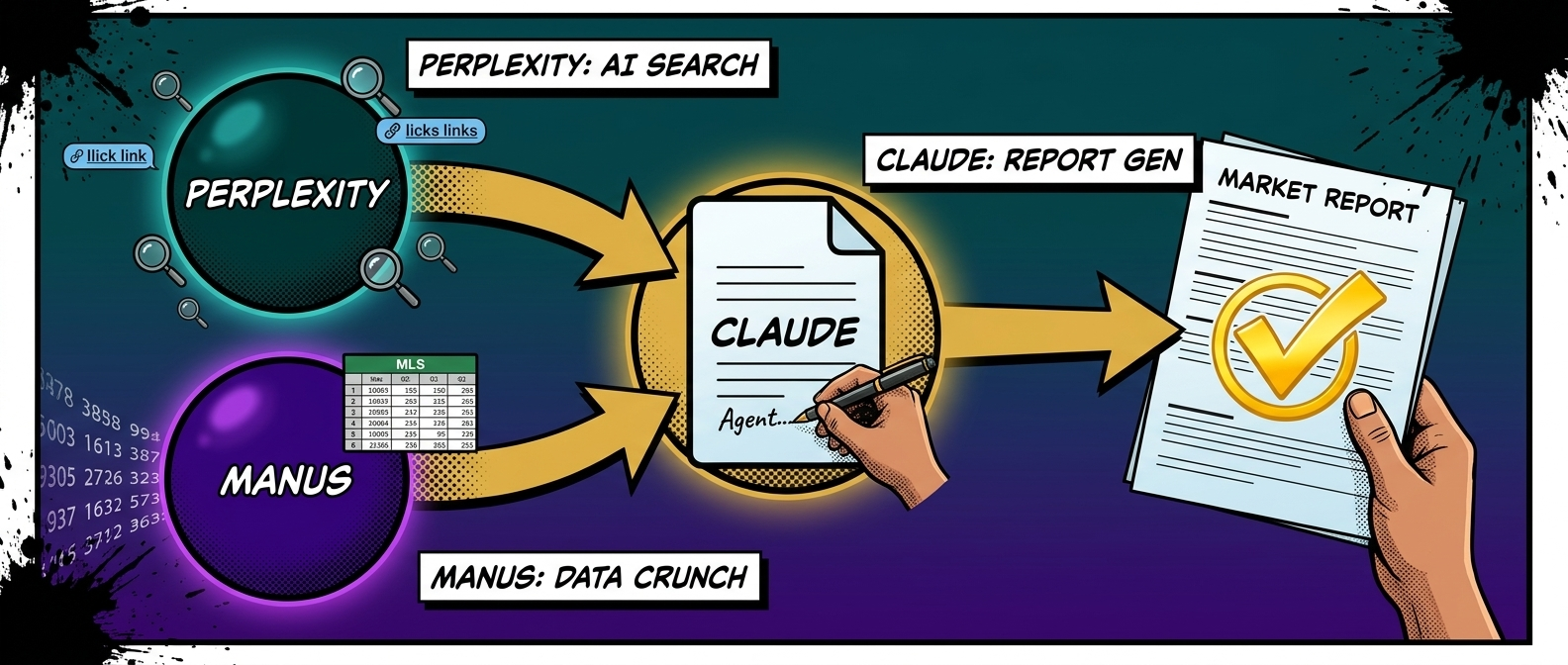
The stack I recommend: Perplexity for real-time research, Manus for interpreting MLS data, and Claude to put both into your voice. I no longer recommend ChatGPT for client-facing research.
Every agent I coach asks some version of the same question. Can I actually put this AI output in front of a client without it coming back to bite me? It is the right question to ask, and the fear behind it is real.
In the RPR AI Adoption Survey this year, 63% of agents named accuracy as their top concern about AI, ahead of compliance and everything else. So if you have felt that hesitation, you are in the majority, not behind. The answer is that yes, you can trust AI for market research, but only once you know where the line sits between what it does and what you check.
The real question is not whether AI is smart, it is who is checking it
Most agents frame trust as a question about the tool. Is ChatGPT good enough, is it accurate, is it safe to rely on.
That framing puts the tool in charge of the truth, which is the mistake. The better frame is a division of labor. AI is the fast assistant that pulls, drafts, and organizes, and you are the licensed professional who signs off on what is true. When you hold that line, AI becomes safe to use on almost anything, because nothing reaches a client until it passes through you. When you blur that line and let the tool be the authority, that is when accuracy problems turn into client problems.
To hold the line well, you have to know exactly where AI tends to break, so let's start there.
Where ChatGPT gets real estate wrong
The word for AI's biggest failure is hallucination, and it is worth understanding before you rely on anything it tells you.
A hallucination is when AI states a fact that is simply not true, and it does it in the same confident tone it uses for everything else. It does not flag the guess, and it reads exactly like the parts that are correct. An Austin-area realtor tested this by asking ChatGPT to value a Hill Country home, and the tool described comparable sales that did not exist. One comp had sold back in 2022, another sat in a different neighborhood, and a third address could not be verified at all. The value it landed on was about 11% low, which on a $680,000 home is a $70,000 miss.
That sounds like a reason to avoid AI, but it is really a reason to use it in the right lane. And there is a wide lane where it is safe.
What AI can safely do in your business
There is a large set of real estate tasks where AI saves you real time and carries almost no risk.
It can brainstorm listing angles, draft your email follow-ups, turn messy open-house notes into a clean summary, and rewrite a paragraph so it reads the way you talk. It can also do math on numbers you hand it, like turning your six real comps into an average price per square foot. The common thread is that AI is either working with information you already trust or producing a draft you were going to review anyway. Nobody gets hurt if the first version of a newsletter needs a tweak.
The risk shows up the moment AI stops assisting and starts supplying the facts, which is the part you have to guard.
What you must always verify yourself
Some work sits too close to the client and the contract to ever leave to a tool.
Pricing is the clearest one. A CMA conclusion, the final number you stand behind, has to come from live MLS data and your read of the market, not from a model guessing at comps. The same goes for any local market claim, like days on market or whether inventory is up, because those numbers move week to week and AI is often working from older training data. Anything contract-sensitive belongs in this group too. The rule is simple: if being wrong could cost your client money or cost you your reputation, you verify it against the source yourself before it goes out.
Once you know which work needs checking, you need a repeatable way to do it, so here is the procedure I give my clients.
A safe operating procedure for AI market research
This is the workflow that lets you move fast without ever putting your name on something wrong. It has three steps, and it does not change.
Step one: you bring the real data
You pull the actual numbers from your MLS, your title rep, or another source you trust. AI does not source the facts. You do.
Step two: AI organizes and analyzes
You hand those numbers to AI and let it do the heavy lifting, summarizing, formatting, and spotting patterns in data you already know is real.
Step three: you verify before it reaches a client
You read every number and every claim against your source one more time. If AI added a stat you never gave it, you cut it or confirm it. Nothing reaches a client until it clears this step.
With that procedure in place, the only question left is which tools to run it with.
So should you use ChatGPT, Claude, or Perplexity?
This is where I have changed my recommendation over the last year, and I am direct with my coaching clients about it.
ChatGPT is fine for low-stakes drafting when you feed it your own information, but I no longer recommend it for client-facing research, because the rate of invented facts is too high for work that has to be accurate. Here is the stack I use instead. For real-time research, I recommend Perplexity, because it pulls current information and shows you the source links, so you can click through and confirm every claim yourself. For interpreting MLS data, I recommend Manus, because it can take the numbers and do the heavy analysis for you. Then you bring both of those into Claude to put the final piece into your voice for the client.
One honest caveat. A source link is not the same as proof, and even Perplexity will sometimes cite a page that does not fully back up the claim, so you still read the source. The tools got better. The verifier is still you.
To see how all of this fits together, here is what it looks like on a real listing appointment.
What this looks like at a real listing appointment
Say you have a listing appointment Thursday in a neighborhood you do not farm often, and you want to walk in sharp.
You start in Perplexity and ask for recent news and development around that zip code, then you click the sources and keep only what checks out. You pull your six real comps from the MLS yourself, hand them to Manus, and let it break down the price per square foot and the trend. Then you drop the verified research and the analysis into Claude and ask it to write a clean one-page market summary in your voice. Before you print it, you run step three and confirm every number against your MLS one more time.
What the seller sees is a sharp, sourced, confident report, and every fact in it passed through you. That is the whole method, and it works the same way whether you are pricing a condo or prepping for a luxury listing.
Wrapping it up
AI did not take your judgment out of the job. It made your judgment the most valuable thing you bring. The tools can pull and draft and organize faster than you ever could, and that is worth using every single day.
Your real job is to stay the person who checks the work before it carries your name. Do that, and you get all the speed without the risk that keeps 63% of agents up at night.
Frequently Asked Questions
Q: Can I use ChatGPT to price a home or build a CMA? A: Not as the source of the number. ChatGPT does not have live MLS access, so it guesses at comps and can invent sales that never happened. Use your MLS data for the actual pricing, and if you want AI involved, have it organize the real comps you already pulled rather than generate the value itself.
Q: Is ChatGPT accurate enough for real estate market research? A: For drafting and organizing your own information, it is fine. For sourcing facts you will put in front of a client, it is not reliable enough on its own, because it can state made-up numbers with total confidence. Anything client-facing needs to be verified against a real source before you use it.
Q: What is an AI hallucination and why does it matter for real estate? A: A hallucination is when AI states something false as if it were true, with no warning that it guessed. It matters in real estate because a made-up comp or an outdated market stat can lead to a bad price or a claim you cannot back up. That is why you verify anything that touches pricing, the contract, or the client.
Q: Which AI is best for real estate research: ChatGPT, Claude, or Perplexity? A: For real-time research I recommend Perplexity, because it shows you the sources so you can confirm each claim. For interpreting MLS data I recommend Manus, and for putting the final report in your voice I use Claude. I no longer recommend ChatGPT for client-facing research.
Q: Can clients tell if I used AI to build their market report? A: They cannot tell that you used a tool, and that is not the problem to solve. The problem to solve is accuracy. If every number in the report is verified against a real source and it reads in your voice, using AI to build it faster is simply good business.
Q: Do I really need to fact-check everything AI writes for me? A: You need to fact-check anything that states a fact a client will rely on, especially numbers, comps, and market claims. You do not need to fact-check a brainstorm or a rough draft you are going to edit anyway. The line is whether being wrong would cost someone something.
Want the whole system?
If this helped, I walk through the exact tools and prompts on my YouTube channel, where I show agents how to research and write with AI without ever risking their name on a bad number. And if you want the full setup built around your voice, the Real Estate Clone Method puts together an AI workflow that drafts in your words while keeping you in the verifier seat. Come find me on YouTube and let's get your market research fast and accurate.
